


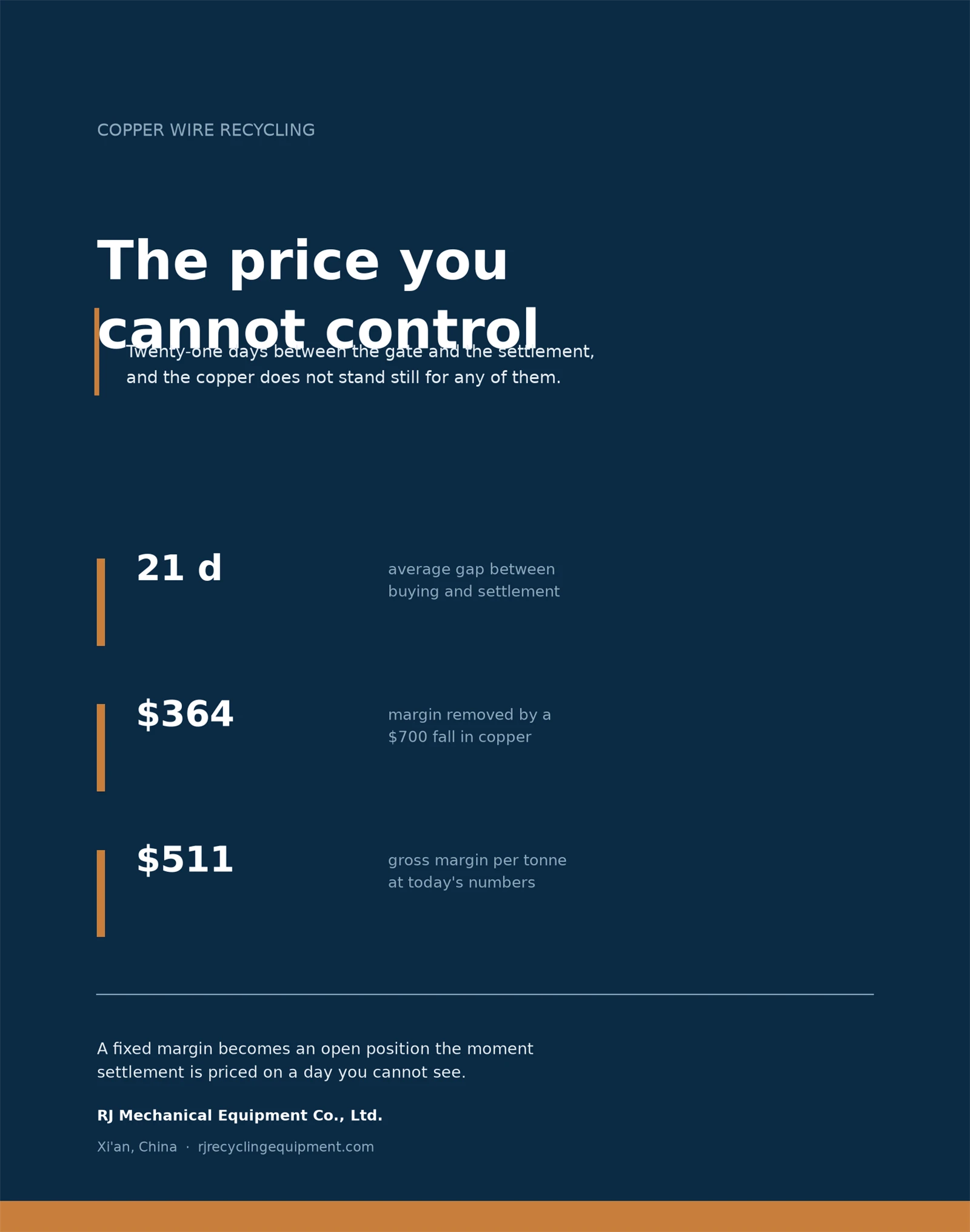
Your margin is not made by the machine. It is set by two dates you do not choose: the day you pay for the cable and the day the mill settles for the granules. Here is what twenty-one days of exposure costs on a tonne of 52% cable, and how to price it in.
A yard in Bekasi bought eleven tonnes of mixed cable on a Monday at USD 2,850. Copper was 8,000 that morning. The owner did the sum he always does - revenue 3,761, material 2,850, processing 400 - and wrote 511 on the corner of the delivery note. That is the number.
Twenty-four days later the mill settled, and the number was 200.
Nothing broke. The machine ran at its usual rate, the copper came off clean, recovery was where it always is. What happened is that copper fell 690 dollars while the material was in his yard and his granules were in a truck, and the settlement was priced on the day the mill assayed the load, not the day he bought it. He had run a good plant and lost 311 dollars a tonne to a calendar.
Two prices, and neither of them is today's
There are two price clocks in this trade and they do not run together.
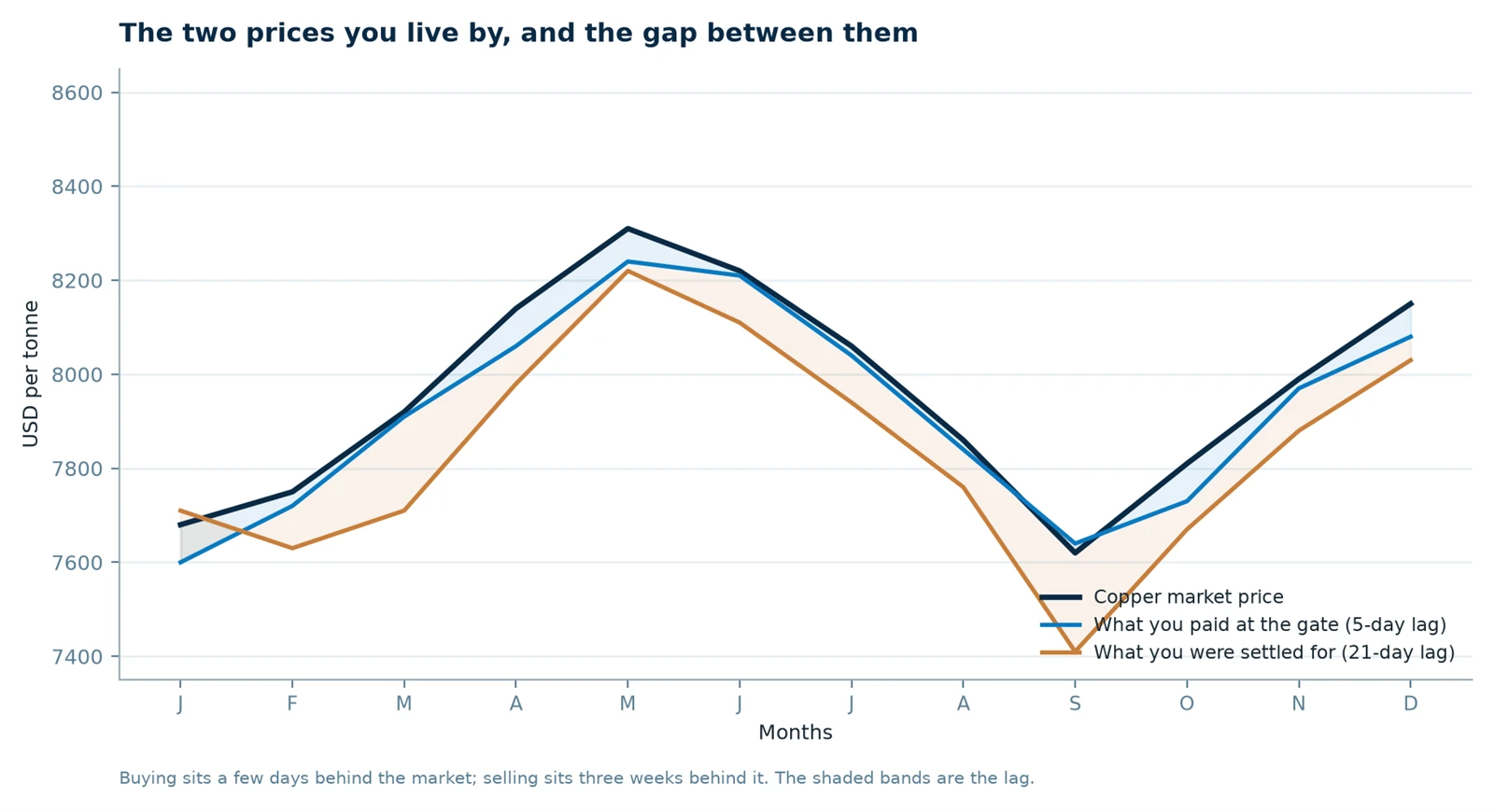
The buying clock is short. A supplier quotes on this morning's number, you agree a price, and the truck arrives a few days later. In practice the material reaches your yard four to six days after the price was spoken, and if you agreed to pay on delivery, the money leaves your account on the day it arrives. Call it five days of lag, and you carry the copper from that moment.
The selling clock is long, and this is where yards get caught. Granules leave your yard, arrive at the mill, get sampled, get assayed, get priced against a quotation that is itself an average of several days, and then the payment terms start. Twenty-one days from load-out to settlement is normal in most markets; thirty is not unusual; forty-five happens when the mill is busy or the assay is disputed. In the case above it was twenty-four.
So your position is this. You own copper at a price fixed around day zero, and you sell it at a price fixed around day twenty-one. Between those two dates you are long copper whether you meant to be or not. Nobody signs a contract for that position. It arrives with the paperwork.
The two clocks also explain something that puzzles buyers who come from other trades: why the same tonne of cable can be profitable in March and loss-making in April with identical material, identical machine and identical labour. The plant did not change. The gap between the clocks absorbed the difference.
What twenty-one days of copper actually costs
The conversion is simple enough to do on the back of an invoice, and worth memorising.
A tonne of 52% cable contains 0.52 tonnes of copper. If copper moves USD 100, the settlement value of that copper moves about USD 52 - call it 45 once the granule discount and the mill's pricing basis are in, which matches what we see on real settlements. So:
Every USD 100 of copper is about USD 45 of revenue on a tonne of 52% cable.
Read that against a gross margin of 511 and the exposure stops being abstract. A 700-dollar fall in copper takes 315 off the tonne. A 1,100-dollar fall takes all of it. And copper does move 700 dollars in three weeks: it fell from 8,310 to 7,620 across four weeks in the autumn, which is exactly the window a yard spends between buying and settling.
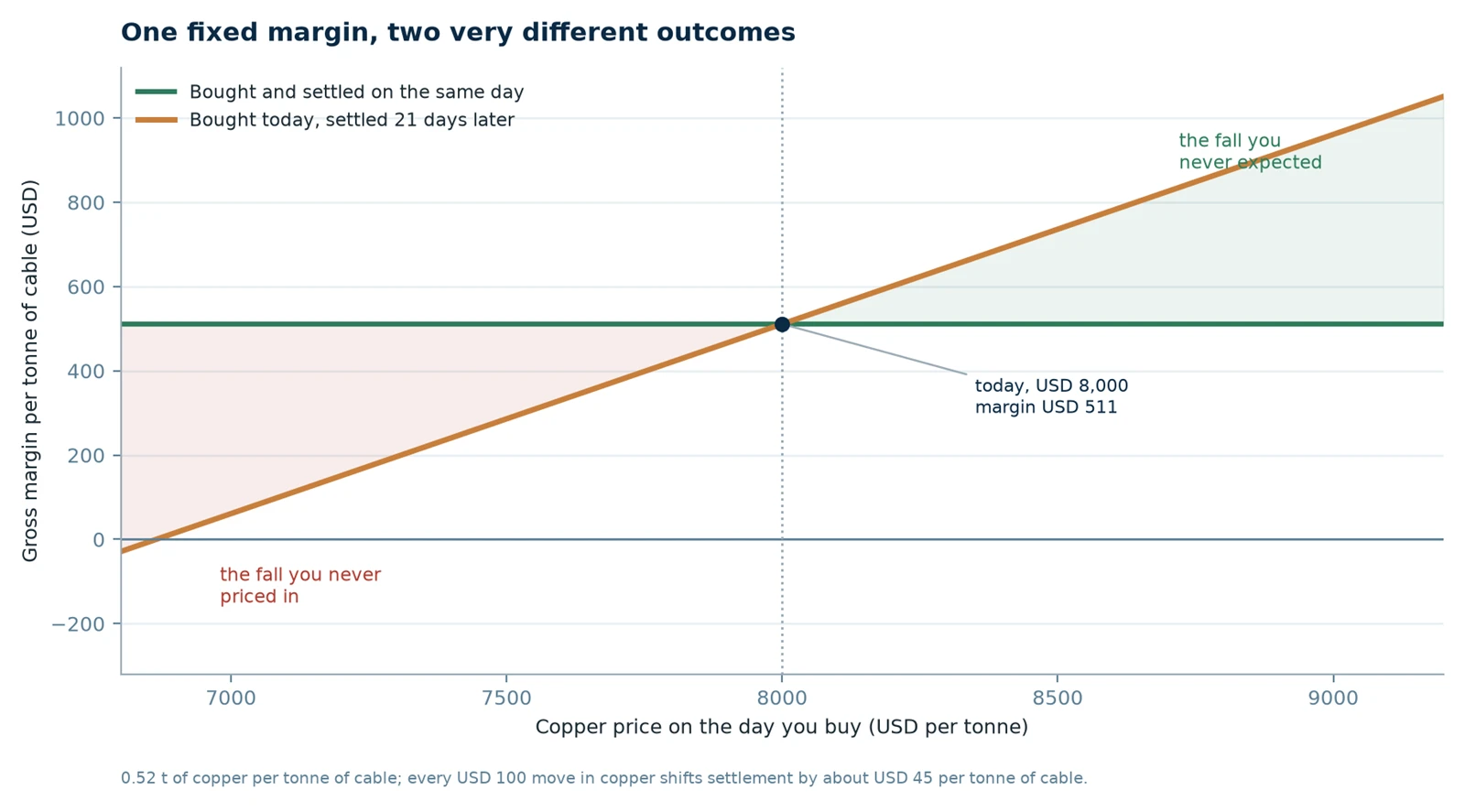
The chart makes the asymmetry plain. If you could buy and settle on the same day, your margin would be a flat line at 511 no matter where copper went - the trade would be a processing business. Once settlement sits twenty-one days out, the flat line tilts, and the tilt is not in your favour by default. It is in your favour when copper rises and against you when it falls, and you have no view on which one is coming.
Worse, the tilt is asymmetric in practice, for a reason that has nothing to do with markets. When copper rises, mills slow their assays and settle later, because a rising price lets them buy time on material they have already received. When copper falls, they settle promptly. You get the slow settlement when it helps you and the fast one when it hurts. That is not malice; it is what any buyer does with a flexible settlement date.
Where the twenty-six days go
Put the two clocks on one line and the whole cost becomes visible.
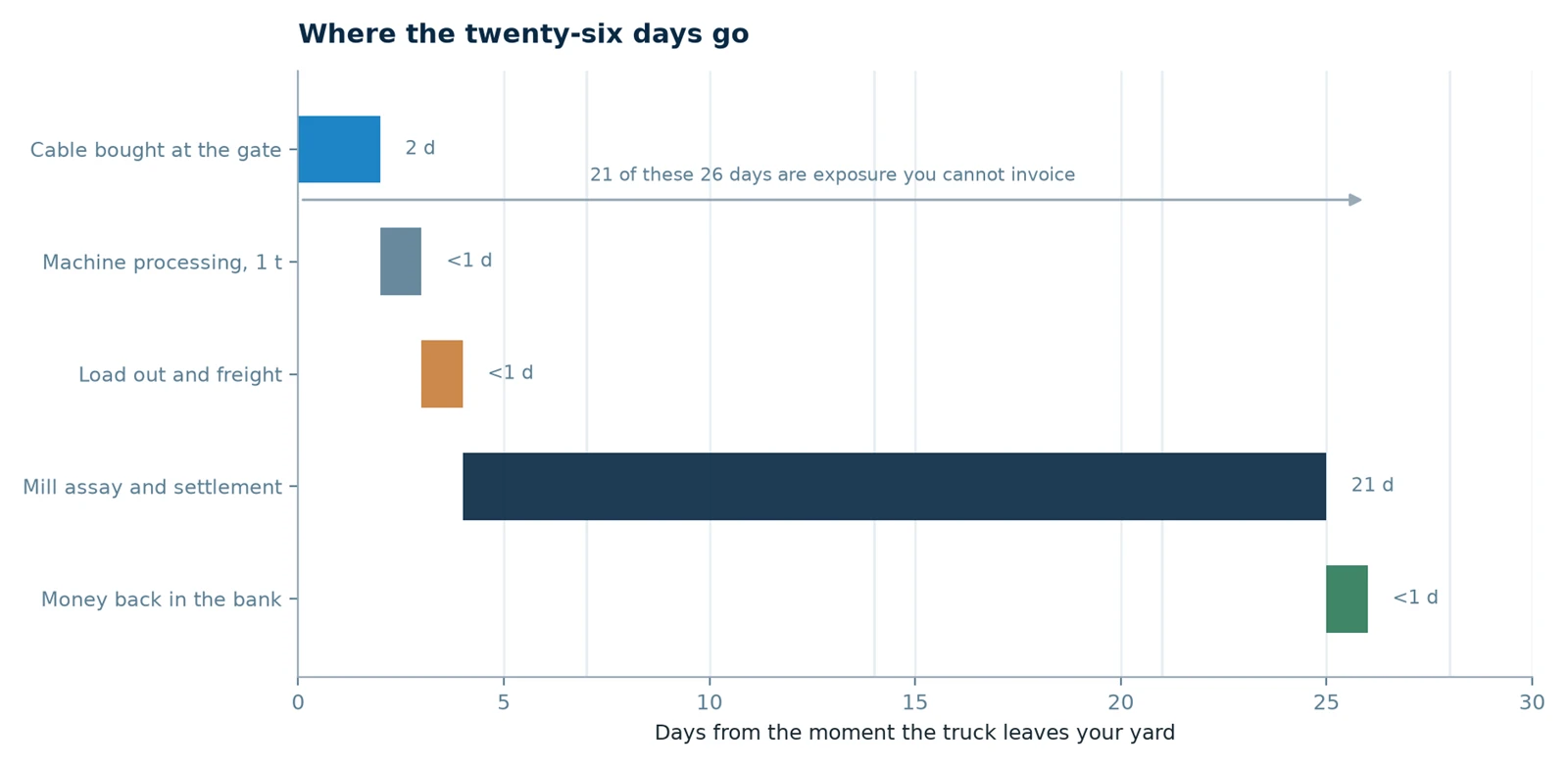
From the moment the truck leaves your yard, the material is gone and the money is not back. Processing is quick - a tonne an hour on a mid-size line means a day's work is a twenty-tonne batch, and the granulating itself is not the constraint. Loading is a day. The assay and settlement block is the long one, and it is the only block where nothing at all is happening in your yard.
The cash consequence is straightforward and usually underestimated. On this tonne you have 2,850 of material and roughly 400 of processing tied up for twenty-six days. That is 3,250 per tonne of working capital in motion. A yard doing twenty tonnes a week is carrying about 65,000 in permanent float, and if the bank is financing the material, the interest on that float belongs in the cost line whether or not the bookkeeper put it there. At 8% annual, twenty-six days on 3,250 is about 18 dollars a tonne. Small next to the price risk, and still larger than most yards' maintenance budget per tonne.
The days also cap your throughput more quietly than the machine does. If a batch takes twenty-six days from gate to bank, your capital turns about fourteen times a year, no matter how fast the granulator runs. A yard that buys a bigger machine to grow will find its growth blocked not by kilograms per hour but by the settlement calendar.
The buffer, drawn to scale
Here is the same exposure as a tolerance band, which is the way to think about it when you are deciding whether to buy a load at all.
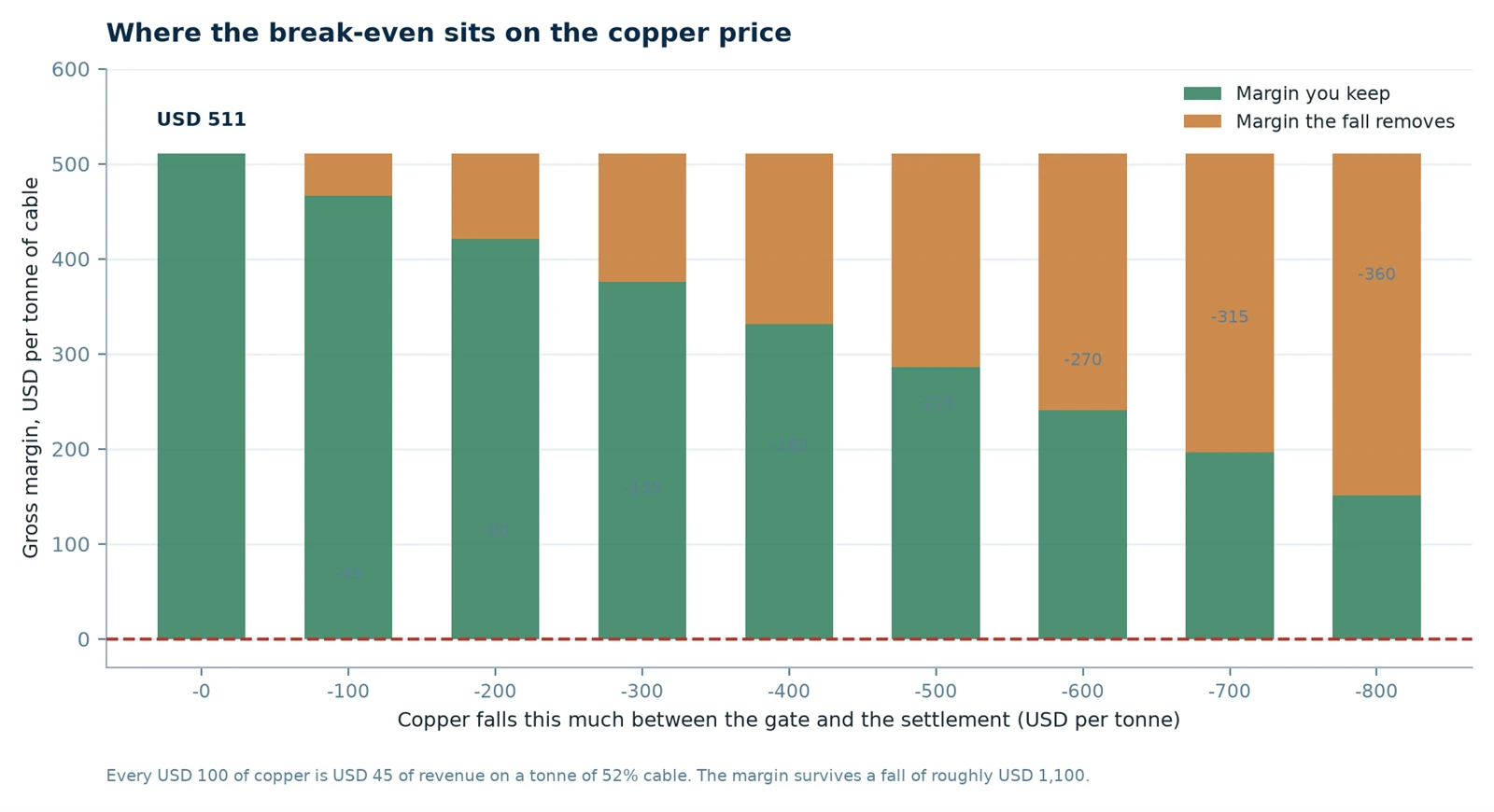
A gross margin of 511 on 52% cable survives a copper fall of roughly 1,100 dollars. That sounds comfortable until you compare it with what copper does. In three weeks, a 5% move is ordinary - that is 400 dollars at current levels, and it removes 180 of the margin, more than a third. A 10% move removes two thirds. The 2022 collapse took copper down more than 20% in a matter of weeks, which on this arithmetic wipes out the tonne entirely and puts you under water on material you already own.
Three ways to live with it, in the order most yards should consider them:
Price it into the gate price. This is the one that costs nothing to adopt. When you calculate a buying ceiling, subtract a provision for the lag. If you expect copper to move within 3% over the settlement window, the provision is 8,000 × 0.03 × 45% ≈ 108 dollars per tonne of cable. That is the number that should come off your ceiling before you make an offer, and it is the number almost nobody deducts. The full ceiling calculation is set out in how to price a load of scrap wire before you pay for it, and the lag provision belongs at the end of it.
Shorten the settlement, even at a small discount. A mill that settles in ten days instead of twenty-one is worth paying for. If the mill offers 6,900 instead of 6,940 but pays in ten days, you have given up about 21 dollars per tonne of cable to remove eleven days of exposure - and eleven days of a 400-dollar fall is roughly 165 dollars of margin. Take that trade every time. Many yards reject the lower price without doing the second half of the sum.
Split the load, split the dates. Instead of selling twenty tonnes on one settlement date, sell four lots across the month. You do not reduce the risk, you average it - and averaging removes the single-day settlement that turns a good month into the Bekasi story. It costs extra sampling and extra paperwork, and it is the cheapest form of hedging available to a yard that will never touch a futures account.
What does not work, in our experience, is waiting for a better price with material already bought. That converts a processing business into a speculative one, and the yard is not capitalised for it. The material starts ageing, the fines oxidise, buyers start asking why the load has been sitting, and the price you were waiting for rarely arrives in the shape you wanted.
The three questions to ask before the next truck
If you take nothing else from this, take the questions. They cost nothing and they change what you are willing to pay.
When, exactly, does the mill price my load - the day it arrives, the day it is assayed, or the average of a week?
What are the payment terms after that date, and how often does that slip in practice, not in the contract?
If copper fell 700 dollars tomorrow, what does today's load earn, and would I still buy it at this price?
The last one is the only one that matters. A price you would not pay after a moderate fall is not a price, it is a position - and it is one you took without being asked.
Where a machine actually helps
None of this makes the machine irrelevant; it changes what you should want from it. A line that recovers two points more copper, or produces granules clean enough to settle at the top of the grade band, adds margin that does not depend on the calendar. On a tonne of cable, two points of recovery is about 0.02 tonnes of copper, roughly 160 dollars at today's numbers - more than the entire lag provision, and it is paid on every tonne regardless of which way the price went.
That is the argument for getting the front end right: clean separation, controlled fines, dry granules, honest grading. It is also why we spend more time on the settling and the feed than on the motor rating. If you are still deciding which machine belongs in front of the copper, stripping or granulating, by wire diameter settles that before it costs you anything. If you want to see what the tonne earns before any of this risk is applied, the full account of one tonne of cable puts every line on one sheet. If the settlement figure itself is what puzzles you, why your granules sell at a discount explains where the 6,940 comes from instead of the 8,000. And if you have not yet decided whether your volume justifies a granulating line at all, what a line costs and how long it takes to pay back is the place to start.
We build granulating and stripping lines for yards that buy on price and sell on assay, and we are happy to sit with your numbers rather than ours. Send a recent settlement sheet and a buying price, and we will work the exposure on your actual mix - including the parts of it that have nothing to do with the machine.
Checklist: pricing a load with the lag included
Confirm the copper reference the mill uses, and the exact day it is applied.
Confirm settlement terms in days, and the realistic average rather than the contractual figure.
Measure copper content by five samples, not by the supplier's claim.
Calculate revenue at the discounted settlement price, never the quotation.
Subtract processing cost per tonne from your own meter readings.
Subtract a lag provision: expected move % × copper price × 45%.
Check the result against a 700-dollar fall. If it does not survive, lower the offer.
Price the fines and the plastic into revenue, not into the waste bin.
Prefer a mill that settles fast over one that pays a fraction more slowly.
Split large loads across settlement dates to average the price.
Track how often settlement actually happens on the agreed date.
Re-run the whole sheet when copper moves more than 5%, not once a year.