


Nothing was broken. The machine was doing exactly what a granulator does. The problem was that he thought of it as a separator, a box where dirty wire goes in one end and clean copper comes out the other. It is not. A granulator is a size-reduction machine with a separation stage bolted onto it, and every separation stage has an efficiency curve. Understanding that curve is the difference between a machine that earns money and one that produces grey mess.
Three things happen inside the chamber, in this order
Wire enters the cutting chamber and meets a rotor turning at 500 to 900 rpm. Between the rotating knives and the fixed bed knives there is a gap, usually set somewhere between 0.2 and 0.5 mm. Copper is ductile; PVC and XLPE insulation are brittle. That difference is the whole basis of the process.
The first thing that happens is impact. A piece of cable is struck, bent, and struck again. The insulation cracks along its length and separates from the conductor because the two materials deform differently under the same blow. This is not a chemical or thermal process, and it does not need water or air to begin. It needs enough energy per kilogram and enough repeated blows.
The second thing is shear. Once the insulation has cracked, the rotor's knives cut the freed copper into short pieces and the insulation into flakes. The screen under the rotor decides how long material stays in the chamber: anything larger than the holes is carried around and hit again, anything smaller drops out.
The third thing is classification. This is where most of the confusion lives. After the material leaves the chamber, an air stream lifts the light plastic flakes and lets the heavier copper granules fall. Some designs add a water tank after this stage, some add a second air pass, a few add electrostatic plates. All of them are doing the same job: exploiting a density or conductivity difference that the cutting stage created.
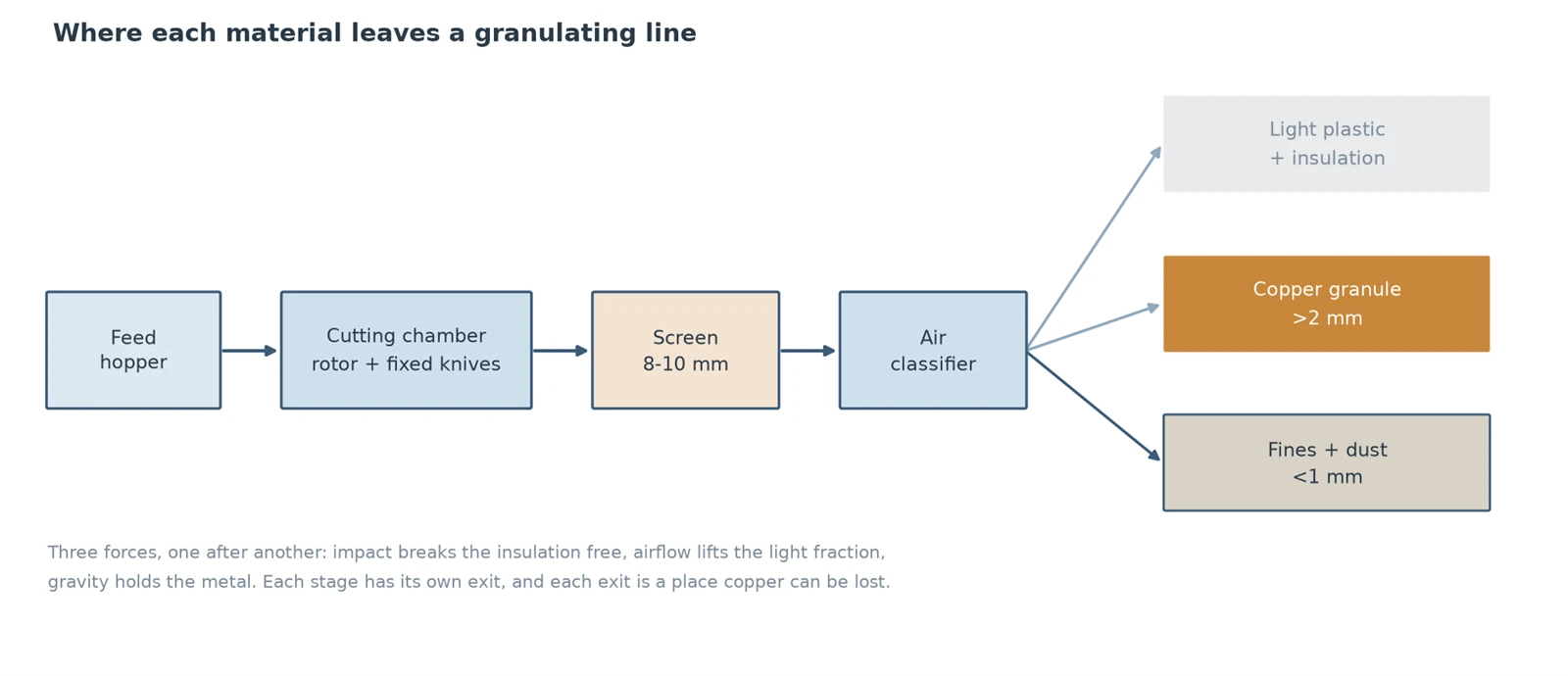
Look at the diagram as three separate exits, not one output. Plastic leaves at the top, copper leaves at the bottom, and fines leave through a third path that nobody designed on purpose. A machine running well still sends material out all three doors. The question is only how much copper goes out the wrong one.
The cutting stage is where separation is won or lost
If the insulation is still wrapped around the copper when it reaches the air classifier, no amount of airflow will fix it. Air classification separates free copper from free plastic. It cannot separate copper from plastic that is still married to each other.
This is why the two settings that matter most are the knife gap and the screen size. A wide gap does not cut; it tears. Torn insulation stays attached in strips, and those strips either leave with the copper (dragging plastic into your product) or leave with the plastic (dragging copper into your tailings). Both outcomes cost money, and both are usually blamed on the "separation system".
A second factor is feed consistency. A chamber fed with a steady ribbon of material cuts it uniformly. A chamber fed in slugs spends part of each cycle running empty and part of it choked. Choked chambers heat up, and hot PVC gets soft and gummy. Once insulation turns gummy it coats the screen, coats the knives, and stops separating altogether.
The third factor is residence time, which the screen controls. Too coarse a screen and partially opened wire leaves before the insulation is fully freed. Too fine a screen and the machine spends its energy making dust instead of granules. The window between those two failures is narrower than most buyers expect, and it shifts with the wire mix.
Air, water, or static: three ways to finish the job
Every granulating line ends with a classification step, and there are three common families. They are not interchangeable in cost, and they are not equal in what they achieve.
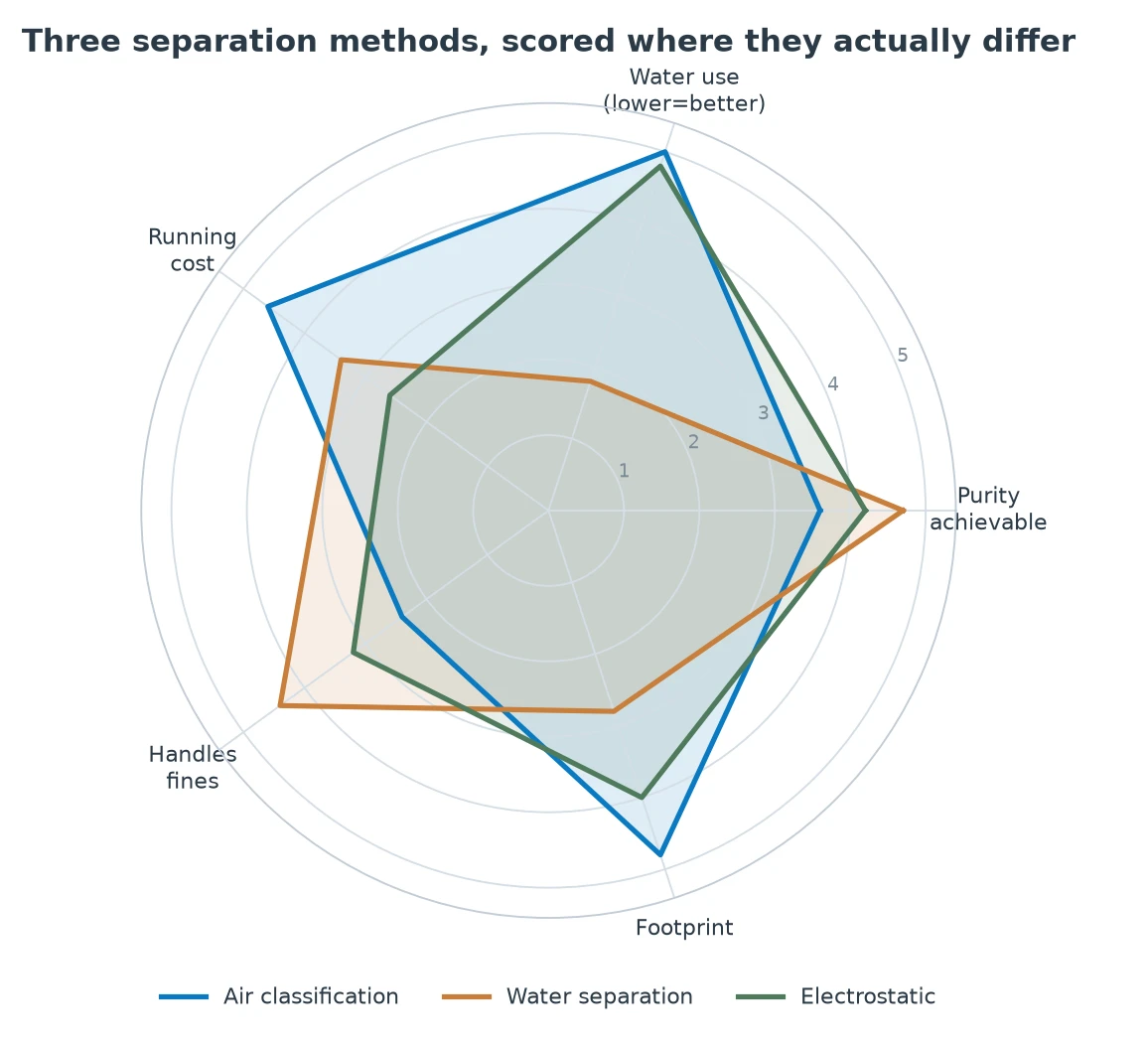
Air classification is the default. A fan moves air through a chamber while material falls through it, and the light fraction is carried away. It is dry, it needs no effluent permit, and it reacts instantly when you change the setting. Its weakness is fines: very small particles have low mass and high drag, so the air cannot reliably tell a 0.3 mm copper speck from a 0.3 mm plastic speck. Those specks tend to follow whichever stream the airflow favours, and often that is the plastic stream.
Water separation uses a tank or a hydro-cyclone, and it works because plastic floats while copper sinks. Purity is typically higher than air classification, especially on fine material. The cost is everything downstream of the tank: the granules come out wet, they must be dewatered and dried, and the water itself becomes an effluent stream that has to be settled, filtered, and topped up. In places where water is cheap and drying is done by the sun, this is a good trade. Where water is metered and the buyer deducts for moisture, it is a liability.
Electrostatic separation charges the mixture and lets a field sort it. On clean, dry, narrow size fractions it is excellent, and it can recover material that air and water both lose. It is also the least forgiving: feed must be dried, dedusted, and closely sized, and a humid day can halve throughput. Few small yards run it as their only method, but as a second pass on tailings it sometimes pays for itself within a year or two.
The honest summary is that no method separates everything. Each one has a size band where it works well and a band where it simply does not. The rest of this article is about where the losses go.
Where the copper actually leaves
Take one tonne of feed at 55% copper content, granulate it on a reasonably well-run line, and trace the mass. About 520 kg leaves as saleable granule. About 420 kg leaves as plastic fraction. Around 40 kg leaves as undersize fines that were never counted as product. Fifteen kilos leave as filter dust. And a small amount, usually between two and five kilos per tonne, is copper still locked inside pieces of plastic that were not fully opened.
Two observations follow from that breakdown. First, the plastic fraction is not clean plastic. It carries copper, sometimes 1 to 3% by weight, and that copper is already paid for at the purchase gate. Second, the fines are not waste either. In most sampled lines, material passing 1 mm still assays 15 to 35% copper depending on the wire mix, and every kilo of it that goes to the dust collector is a kilo of metal bought at full price and sold at zero.
Where that copper goes, and how much of it can be pulled back, is a separate subject and gets its own treatment in Where the last eight percent of copper goes.
The one number that keeps yards honest
Recovery rate is the only metric that captures all of this at once. Measure it by weighing the copper you sell and dividing by the copper you bought, using assays rather than assumptions. A line that runs smoothly and looks busy can still be at 88%; a line with a fussy operator who cleans the screen twice a shift can be at 95%.
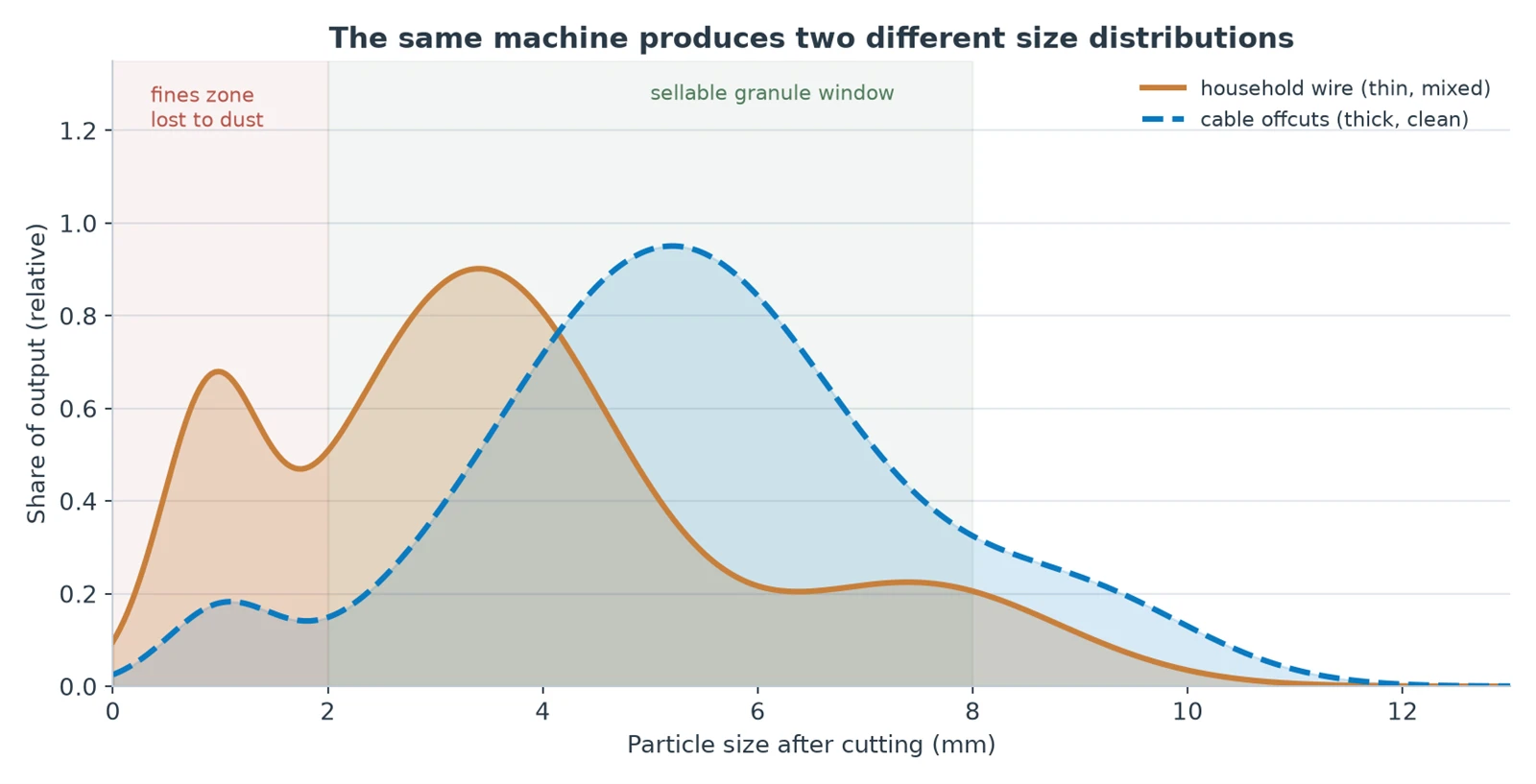
The size distribution above explains why. Thin household wire produces a distribution with a large fines shoulder; thick cable offcuts produce one shifted right into the saleable window. Same machine, same settings, two different outcomes. This is why a capacity figure quoted for a machine means very little until you know what was fed into it, and why the same model can be excellent in one yard and disappointing in another three kilometres away.
What to do differently tomorrow
Cut a 200 kg sample of each wire type you buy and granulate it separately. Weigh product, tailings, fines and dust. Most yards have never done this once and are working from a brochure number.
Check the knife gap with a feeler gauge, not by eye. Any gap above 0.5 mm on thin wire is a recovery problem, not a maintenance preference.
Look at the plastic fraction for copper strands. If you can see shiny metal in it, the cutting stage is not freeing the insulation, and adjusting the air classifier will not help.
Sample the fines bin and send one 1 kg bag for assay. The result usually changes how the yard treats that bin.
Record the screen size and air setting for the best week you ever had, and treat that as the baseline. Chasing settings week by week without a baseline is how machines drift.
Related Equipment
If you are sizing a granulating line for mixed household wire or cable offcuts, our copper wire granulator range covers throughputs from small single-unit setups to two-stage lines with integrated dust collection. Send us your wire mix and monthly tonnage and we can tell you which configuration fits, and which one is oversized for your feed.
Contact information
Contact name: Jonathan Lee
Email: sales01@rjrecyclingequipment.com
Cell phone: +86 183 9200 1872
Whatsapp: +86 183 9200 1872
website: https://www.rjrecyclingequipment.com/