


1.Based on data gathered during on-site commissioning and after-sales service for over 200 waste recycling production lines delivered by RJ Mechanical, approximately 35% of first-time facility operators select shredding technology that is ill-suited for the materials they intend to process. These operators often prioritize a lower initial purchase price, only to subsequently face wear-part costs two to three times higher than expected, frequent unplanned downtime, and output that fails to meet the requirements of downstream sorting processes.
2.There is no universally "better" machine. Double-shaft shredders and hammer mills are built on completely different working principles, designed for entirely different feedstock characteristics and process positions in the line. Choosing the wrong one does not just shorten equipment life - it raises per-ton processing cost by 30–40% and drags down overall line efficiency.There is no universally "better" machine. Double-shaft shredders and hammer mills are built on completely different working principles, designed for entirely different feedstock characteristics and process positions in the line. Choosing the wrong one does not just shorten equipment life - it raises per-ton processing cost by 30–40% and drags down overall line efficiency.

1. Core Working Principles & Design Intent
Before comparing specs, understand the fundamental design logic that determines where each machine excels.
Double Shaft Shredder
Double-shaft shredders use two counter-rotating shafts fitted with interlocking cutting blades. They operate at low speed (20–40 rpm) and extremely high torque, shearing and tearing material apart through meshing blade action.
Core design logic: Handle bulky, irregular, high-hardness and high-toughness materials through slow, powerful shearing. Built for impact resistance and long wear life under heavy load.
Typical line position: Primary coarse shredding at the front of the process flow, reducing large bulk scrap into manageable 50–150mm pieces for downstream processing.
Hammer Mill
Hammer mills use a high-speed rotating rotor with swinging or fixed hammers that impact, grind and shatter material against screen plates and liner plates. They operate at hundreds of rpm, relying on kinetic impact to reduce particle size.
Core design logic: Reduce medium-sized, brittle or low-hardness material to uniform fine particles through high-speed impact. Built for high throughput of homogeneous, low-abrasion feedstock.
Typical line position: Secondary fine shredding after primary coarse crushing, producing 10–30mm uniform particles optimized for downstream sorting.
2. Head-to-Head Performance Comparison
The table below summarizes real-world operating parameters for both machine types at comparable throughput levels, based on mixed household appliance and light industrial scrap.
| Performance Metric | Double Shaft Shredder (800-type) | Hammer Mill (same throughput class) |
|---|---|---|
| Shredding mechanism | Low-speed high-torque shearing & tearing | High-speed impact & grinding |
| Optimal feed material | Bulky irregular scrap: whole motors, compressors, radiators, thick steel, bundled wire | Brittle / thin material: thin sheet steel, cast aluminum, pre-shredded scrap, non-ferrous offcuts |
| Maximum feed size | Up to 600×800mm bulk pieces | Up to 200mm medium pieces |
| Typical discharge particle size | 50 – 150mm (adjustable by blade gap) | 10 – 30mm (controlled by screen aperture) |
| Wear part service life (mixed scrap) | H13 alloy blades: 6–12 months between sharpening; 3–5 year total life | Manganese steel hammers: 6–8 weeks between replacement; 6–12 month total rotor life |
| Energy consumption per ton | 18 – 25 kWh/ton | 22 – 30 kWh/ton |
| Impact resistance | Extremely high; handles solid steel blocks without catastrophic failure | Low; solid hard objects cause hammer fracture and rotor damage |
| Maintenance difficulty | Moderate; blade replacement and gap adjustment require 4–8 hours | Low to moderate; hammer replacement takes 2–4 hours, but much more frequent |
| Noise level | 75 – 85 dB(A) | 90 – 100 dB(A) |
| Upfront equipment cost | Higher (heavy frame + alloy blade system) | Lower for equivalent throughput |
| Annual consumable cost | Low to medium | 2 – 3x higher for mixed metal scrap |
Field observation: In our after-sales records, the most common hammer mill failure pattern is fractured hammer pins and cracked rotor discs after repeated impact with hidden solid steel blocks - a problem that almost never occurs on properly sized double-shaft shredders with automatic anti-jam reversal.
3. Which Fits Your Operation? Scenario-by-Scenario Breakdown
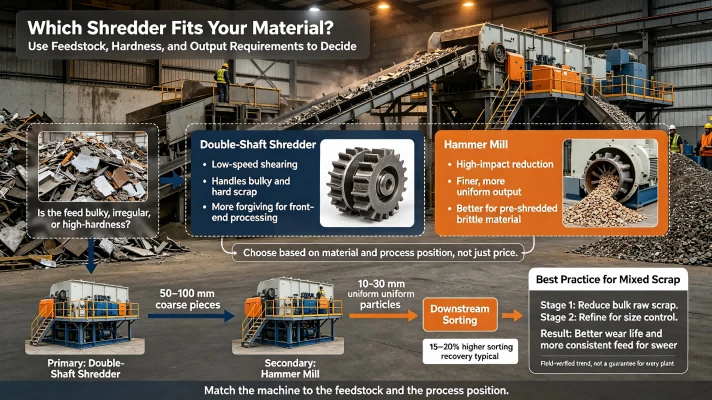
Use these rules to match machine type to your actual feedstock and process requirements.
Choose a Double Shaft Shredder if:
You process bulky, irregular raw scrapWhole appliances, electric motors, AC compressors, bundled wire, structural steel offcuts and mixed bulky waste are all ideal feed for double-shaft shearing action. These materials will jam or destroy a hammer mill in short order.
High-hardness scrap makes up 20%+ of your feedIf your feed contains thick steel, cast iron parts or other high-hardness fractions, the low-speed shearing action of a double-shaft machine delivers dramatically longer wear life. For 30%+ steel content, annual hammer mill consumable costs can reach 3x the price of the machine itself.
You need reliable low-maintenance front-end processingIf you run long shifts with limited on-site maintenance staff, double-shaft shredders are far more forgiving. They tolerate occasional foreign objects, require less frequent consumable replacement, and have fewer moving parts subject to fatigue failure.
Choose a Hammer Mill if:
You need fine, uniform output for downstream sortingEddy current separators, air classifiers and gravity sorting tables all perform best with consistent 10–30mm feed. A hammer mill delivers far more uniform particle size than a double-shaft shredder, directly improving downstream separation efficiency.
Your feed is pre-shredded and low-hardnessHammer mills excel as secondary fine-shredding equipment after primary coarse shredding. Feeding pre-sized 50–100mm pieces into a hammer mill produces consistent fine output at high throughput, with far lower wear than feeding raw bulk scrap directly.
You process mostly brittle non-ferrous scrapFor cast aluminum, zinc die-castings, thin copper tubing and similar brittle materials, hammer mills deliver higher throughput per kW of installed power than double-shaft shredders.
Best Practice: Two-Stage Shredding for Maximum Efficiency
For most professional mixed scrap lines, the optimal configuration is not one or the other - it is both in sequence:
Primary stage: Double-shaft shredder reduces bulk raw scrap to 50–100mm coarse pieces
Secondary stage: Hammer mill refines to uniform 10–30mm particles
Result: High overall throughput, long wear life on both machines, and perfectly sized feed for downstream sorting
Plants running this two-stage configuration typically see 15–20% higher downstream sorting recovery than plants using a single shredding stage.
4. 3 Most Costly Selection Mistakes
These three errors appear repeatedly across underperforming lines, and all are completely avoidable.
Mistake 1: Using a hammer mill for raw bulky scrap with steel content
This is the #1 most expensive mistake. Many buyers select hammer mills for higher advertised throughput, only to discover that hammers and screens wear out in weeks when processing mixed scrap with steel components.
Real case example: A client in Nigeria initially purchased a hammer mill for mixed appliance scrap. Hammer sets lasted 5–6 weeks, with annual consumable costs of $19,000. After switching to a double-shaft shredder for primary coarse shredding, annual blade consumable costs dropped to $5,200.
Mistake 2: Using a double-shaft shredder where fine output is required
Double-shaft machines produce a wide particle size distribution with long strips and irregular pieces. If you try to run this material directly into an eddy current separator or copper granulator, you will get 10–15% lower separation efficiency. If you need fine uniform output and only buy a double-shaft shredder, you are trading lower wear for lower recovery value.
Mistake 3: Selecting based on upfront price only
Hammer mills almost always have a lower sticker price for the same rated throughput. But when you add the cost of 4–6 hammer replacements per year, higher downtime and higher energy use, the total 3-year cost of ownership is often higher for a hammer mill on mixed metal scrap.
5. 3-Year Total Cost of Ownership Comparison
The table below compares real total operating cost for both machine types processing 30 tons per day of mixed household appliance scrap, 250 working days per year.
| Cost Item | Double Shaft Shredder (Primary Coarse Shredding) | Hammer Mill (Direct Raw Feed) |
|---|---|---|
| Upfront equipment purchase | $18,000 – $25,000 | $12,000 – $18,000 |
| Annual wear parts cost | $4,500 – $6,000 | $14,000 – $19,000 |
| Annual downtime loss | $2,500 – $4,000 | $8,000 – $12,000 |
| Annual power cost | $16,800 | $20,200 |
| 3-year total cost of ownership | $81,900 – $112,000 | $98,600 – $147,600 |
For mixed scrap with significant steel content, the lower-priced hammer mill ends up costing 20–30% more over 3 years. For clean non-ferrous brittle scrap, the gap narrows and the hammer mill becomes competitive.
6. RJ Mechanical Shredding Solutions
At RJ Mechanical, we never push one technology over another. We recommend the configuration - single or two-stage - that delivers the lowest total cost and highest recovery for your specific feedstock.
What we offer
Full range of both machine types
Double shaft shredders: 600, 800, 1000 and 1200 models, with optional Cr12MoV or H13 blade grades
Hammer mills: matched secondary fine-shredding models for 10–30mm outputAll machines are built with heavy-duty frame construction for real scrap yard conditions.
Free feedstock testingSend us samples of your actual scrap material. We run test trials on both machine types, measure output particle distribution, estimate wear life and recommend the most cost-effective configuration for your volume and material.
Optimized two-stage shredding linesFor mixed scrap lines with downstream sorting requirements, we design matched primary + secondary shredding systems tuned to deliver the exact output particle size your eddy current separator or copper granulator needs for maximum recovery.
On-site commissioning & operator trainingOur technicians calibrate blade gaps, screen sizes and rotor speed on site with your actual material, and train your team on proper maintenance and wear part replacement schedules.
Final Note
There is no universal winner between double-shaft shredders and hammer mills. There is only the right match for your feedstock, your required output particle size and your operating conditions.
The biggest mistake new plant owners make is choosing based on advertised throughput and upfront price, without calculating the full cost of consumables, downtime and lost downstream recovery. A cheaper machine that costs more to run every month is not a bargain. For most mixed metal scrap operations, a double-shaft shredder for primary coarse shredding is the most reliable, lowest total-cost starting point; add a hammer mill for secondary fine shredding once your volume and sorting requirements justify it.
If you are unsure which shredding technology fits your operation, send us a description of your feedstock and target output, and we will provide a side-by-side performance and cost projection for both options.