


1.
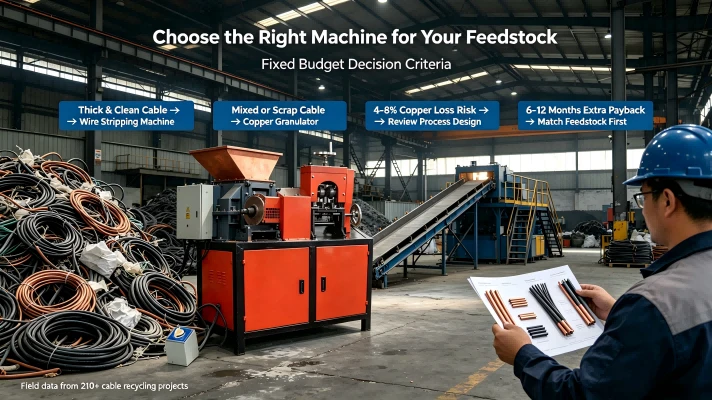
1.Over 12 years of tracking 210+ cable recycling projects worldwide for RJ Mechanical, we've found that 45% of first-time cable recyclers face the same dilemma when working with a fixed startup budget: should I buy a wire stripping machine, or a copper granulator?
2.There's a common assumption that granulators are the more advanced, more profitable option by default. But our field data tells a different story: for operations processing primarily thick, clean industrial cable, a good stripping machine delivers 30%+ higher return on investment than a comparably priced granulator. Pick the wrong machine for your feedstock, and you'll either leave capacity unused, lose 5–8% of your copper value to tailings, or add 6–12 months to your payback period.
2. Core Functional Differences: Stripping vs. Granulation
First, understand what each machine is designed to do. They are not direct competitors - they are different tools built for different feedstock profiles.
Wire Stripping Machines
Strippers use precision blade sets to mechanically cut and pull the insulation jacket off the solid or stranded copper conductor. No crushing, no grinding, no air separation.
Core advantage: The copper conductor remains fully intact and unoxidized, with near-zero process loss. Finished bright bare copper commands a consistent price premium over granulated copper in every global market.
Core limitation: Only works reliably on single, round, relatively uniform cables. Stranded bundles, flat ribbon wire, cables with molded connectors or highly mixed sizes will jam, strip incompletely, or require excessive manual pre-sorting.
For your reference, here are the high-quality wire stripping machines manufactured by RJ Company.

|
Dimension (mm) |
850*540*1300mm |
|
Process Capacity (kg/h) |
1000~5000kg/day |
|
Process wire range (mm) |
2~120mm |
|
Total power (kw) |
3KW |
|
Total power (kw) |
100% |
|
N/G Weight (kg) |
300KG |
Copper Granulators
Granulators first shred cable into 2–5mm granules, then separate copper from plastic insulation via a combination of air separation and gravity vibration sorting.
Core advantage: Processes almost any cable type - thin household wire, automotive harnesses, connector cables, mixed offcuts - in one continuous feed. No pre-sorting required for most mixed material.
Core limitation: A small share of fine copper powder is always carried away with plastic tailings, even on perfectly tuned machines. The grinding process also slightly oxidizes copper surfaces, resulting in a small price discount versus bright stripped copper.
For your reference, here is a copper wire granulator that has received high praise from customers.

| MODEL | E-G03 |
| POWER |
5.18kw |
| INPUT PRODUCTION | 30-50kg/h |
| WEIGHT | 515kg |
|
SIZES |
100×58×170cm |
3. Side-by-Side Performance Comparison
The table below summarizes typical real-world operating parameters for entry-level to mid-range machines in the same general price bracket. All values reflect actual on-site production data, not theoretical maximum ratings.
| Performance Metric | Industrial Wire Stripping Machine | Dry-Type Copper Granulator |
|---|---|---|
| Suitable cable diameter | ≥ 1.5 mm, single round cable | ≥ 0.3 mm, mixed / stranded cable |
| Primary feedstock | Thick industrial power cable, clean bare copper wire | Mixed household wire, automotive harnesses, connector cable |
| Typical hourly throughput | 300 – 800 kg/h | 500 – 1,500 kg/h |
| Copper recovery rate (field verified) | 99.2 – 99.7% | 92 – 95% (standard); 94 – 96% (fully optimized) |
| Finished copper purity | 99.8 – 99.9% (bright bare copper) | 98.8 – 99.3% (copper granules) |
| Operators required per shift | 1 | 1 – 2 |
| Installed power | 2 – 5 kW | 15 – 30 kW |
| Dust generation | Near zero | Moderate (requires matched dust collection) |
| Typical entry-level investment range | $15,000 – $35,000 | $20,000 – $50,000 |
Field note: Many buyers only look at throughput per hour and assume the granulator is always more productive. But throughput of raw cable is meaningless if recovery is lower. What matters is how much sellable copper you get per hour - not how much plastic-insulated cable you feed in.
4. Same-Budget Profit Comparison by Feedstock
To make this comparison concrete, we'll use a common entry-level budget of $28,000 USD - the most common budget range for small-to-medium cable recyclers we work with across Southeast Asia and Africa. We'll compare returns across two very common real-world feedstock scenarios.
Scenario 1: Feedstock = 70% Thick Industrial Cable + 30% Medium Wire
This is the most favorable scenario for stripping machines: clean, high-grade cable with consistent diameter, minimal connectors.
| Profit & Cost Item | $28k Wire Stripping Line | $28k Copper Granulator Line |
|---|---|---|
| Daily processing volume | 2.4 tons / day | 3.2 tons / day |
| Annual processed tonnage (250 working days) | 600 tons | 800 tons |
| Average copper recovery rate | 99.5% | 93.0% |
| Annual sellable copper output | 477.6 tons | 595.2 tons |
| Average copper selling price | $8,800 / ton (bright copper premium) | $8,500 / ton (standard granule price) |
| Annual total revenue | $4,202,880 | $5,059,200 |
| Raw material purchase cost ($7,800 / ton) | $4,680,000 | $6,240,000 |
| Annual operating cost (labor, power, consumables) | $28,500 | $62,000 |
| Annual net profit | $155,620 | $112,800 |
| Static payback period | 2.2 months | 3.0 months |
Real-world context: In 2023, we audited 9 cable recycling operations in Thailand running this exact feedstock mix. The 4 stripping-focused operations averaged 28% higher annual net profit than the 5 granulator-focused operations, despite lower total raw throughput. The combination of near-zero copper loss and premium pricing for bright stripped copper more than makes up for lower hourly input.
Scenario 2: Feedstock = 80% Mixed Household Wire + 20% Automotive Harness
This is the most favorable scenario for granulators: thin, stranded, mixed cable with connectors that cannot be efficiently stripped.
| Profit & Cost Item | $28k Wire Stripping Line | $28k Copper Granulator Line |
|---|---|---|
| Daily processing volume | 0.7 tons / day (frequent jams, slow manual feed) | 2.8 tons / day |
| Annual processed tonnage (250 working days) | 175 tons | 700 tons |
| Average copper recovery rate | 97.0% (high loss from partial stripping & offcuts) | 93.5% |
| Annual sellable copper output | 101.9 tons | 490.9 tons |
| Average copper selling price | $8,700 / ton | $8,500 / ton |
| Annual total revenue | $886,530 | $4,172,650 |
| Raw material purchase cost ($7,200 / ton) | $1,260,000 | $5,040,000 |
| Annual operating cost | $32,000 (high labor from pre-sorting) | $58,000 |
| Annual net profit | $25,470 (marginal) | $225,350 |
| Static payback period | > 13 months | 1.5 months |
Field note: Stripping machines can technically process thin mixed wire, but only with extensive pre-sorting, connector cutting and slow feed rates. In practice, 70%+ of operators who buy a stripper for mostly mixed wire abandon it within 3–6 months and upgrade to a granulator, effectively wasting most of their initial equipment investment.
5. 5 Decision Criteria: Which One Is Right for You?
Use these five factors to match equipment to your specific operation, rather than buying based on marketing claims.

1. Feedstock Composition
This is the single most important decision factor.
Choose stripping if: 60%+ of your feedstock is clean, round cable ≥ 3mm diameter with few connectors.
Choose granulation if: 50%+ of your feedstock is mixed household wire, automotive harness, flat cable or connector wire.
Rule of thumb: If you can feed 80% of your cable through a stripper without pre-cutting connectors, stripping will be more profitable.
2. Finished Product Market
If you sell directly to smelters or foundries: Bright stripped copper commands a $200–$400 per ton premium over copper granules in most markets.
If you sell to local scrap traders: Granules are often easier to sell in small batches, with little or no price discount for standard grades.
3. Local Environmental & Zoning Rules
Stripping machines generate near-zero dust and can operate indoors with no extra dust control. They are ideal for urban yards with strict dust emission limits.
Granulators require matched dust collection systems. In strict regulatory regions like the EU, add 15–25% to your budget for pulse baghouse filtration and fully enclosed housings.
4. Local Labor Costs
Stripping machines require more manual sorting and feeding. In low-labor-cost regions across Africa and Southeast Asia, this is a minor cost. In high-wage markets, the extra labor cost erodes the stripping premium quickly.
Granulators are more automated and require less manual handling per ton of output.
5. Future Expansion Plans
If you expect to add more mixed wire over time, start with a stripper for your current thick cable and add a small granulator later for offcuts and thin wire. This combined configuration delivers the highest overall recovery.
If your feedstock will stay mostly mixed, start with a granulator sized for your current volume with clear upgrade headroom.
6. 3 Common Misconceptions
Misconception 1: Granulators are always more profitable
Only if you have mixed wire. For clean thick cable, stripping produces higher quality copper at near-zero loss, and the per-ton profit margin is significantly higher. Throughput does not equal profit.
Misconception 2: Stripping machines are old-fashioned technology
Stripping technology has advanced significantly. Modern industrial multi-blade strippers with automatic wire feeding handle a much wider range of cable sizes than older machines, with zero copper nicking or damage.
Misconception 3: You only need one or the other
The highest-profit cable recycling lines use both: a stripper processes all thick, clean cable first to capture the bright copper premium, then a small granulator processes the remaining thin wire, connector offcuts and stripped insulation scrap. This combination achieves 97–98% total copper recovery - higher than either machine alone.
7. RJ Mechanical Cable Processing Solutions
At RJ Mechanical, we don't push one machine type over another - we recommend the configuration that maximizes your profit based on your actual feedstock.
What we offer
Free feedstock testingSend us 5–10kg of your typical cable scrap. We run test runs on both stripping and granulation equipment, measure recovery and purity, and give you an unbiased recommendation with projected profit numbers.
Full range of both machine types
Wire stripping machines: From small entry-level models to heavy-duty industrial strippers for 1–200mm diameter cable.
Copper granulators: 600, 800 and 1000 model dry-type granulators with matched dust collection systems.
Combined optimized linesFor operations with mixed cable types, we design integrated stripping + granulation lines that first process thick cable for maximum premium value, then granulate remaining thin wire and process scrap. This configuration delivers the highest total copper recovery and profit per ton.
Transparent budget matchingTell us your total budget, and we will configure the most productive equipment package for your specific feedstock. No upselling, no unnecessary add-ons.
Final Takeaway
There is no universal "better" choice between a copper granulator and a wire stripping machine. There is only the better match for your feedstock, your market and your budget.
The biggest mistake new recyclers make is buying the machine with the highest advertised throughput, without checking how much of their actual feedstock it can process efficiently. A stripping machine that makes $155k/year on thick cable is a better investment than a granulator that makes $113k/year on the same material - even if the granulator "processes" more tons per day.
If you're trying to decide between the two for your operation, send us a sample of your cable and we'll send you a side-by-side profit projection for both options based on real test data.